Table of contents
- A Developer That Resists the Tower Reflex
- Al Wasl: A Neighbourhood Quietly Reinventing Itself
- The Architecture: Restraint As a Statement
- Amenities Calibrated for Residents, Not Brochures
- A Slower, Quieter Sales Process
- Investment Mechanics In The Background
- A Launch That Sets a Tone
- The Wider Market Context
In a city that has come to expect spectacle, the most discussed new address of the season has arrived almost in silence. There is no neon-lit construction hoarding on Sheikh Zayed Road, no ninety-second cinematic teaser, no celebrity ribbon-cutting. Instead, a discreet sales pavilion in Al Wasl has been quietly welcoming a curated list of brokers, family offices and returning buyers. The project at the centre of this hush is Eden House The Park, the latest residential statement from H&H Development, and within Dubai’s prime real estate circles it is already being treated as the boutique launch of 2026.
A Developer That Resists the Tower Reflex
For the better part of two decades, Dubai’s luxury narrative has been written in glass towers stacked along the coastline and the financial spine of the city. H&H Development has spent that same period deliberately stepping sideways. The studio is small by Dubai standards, intentionally so, and its portfolio reads more like a curated collection than a catalogue. Eden House Dubai Hills, completed during the post-pandemic surge, was the project that crystallised the developer’s reputation: a low-rise residential building wrapped around a central wellness floor, designed around residents rather than around skyline visibility.
Casa Tessuto in Jumeirah followed, leaning further into the language of textiles, tactile surfaces and softly lit interiors. Casa Canal, completed on a prime stretch of the Dubai Water Canal, pushed the same logic into a waterfront register, with private moorings and full-floor residences. Knight Frank’s recent prime residential commentary has repeatedly grouped these schemes under the heading of “ultra-prime boutique,” a category the consultancy notes has grown faster than the broader luxury market over the past three years.
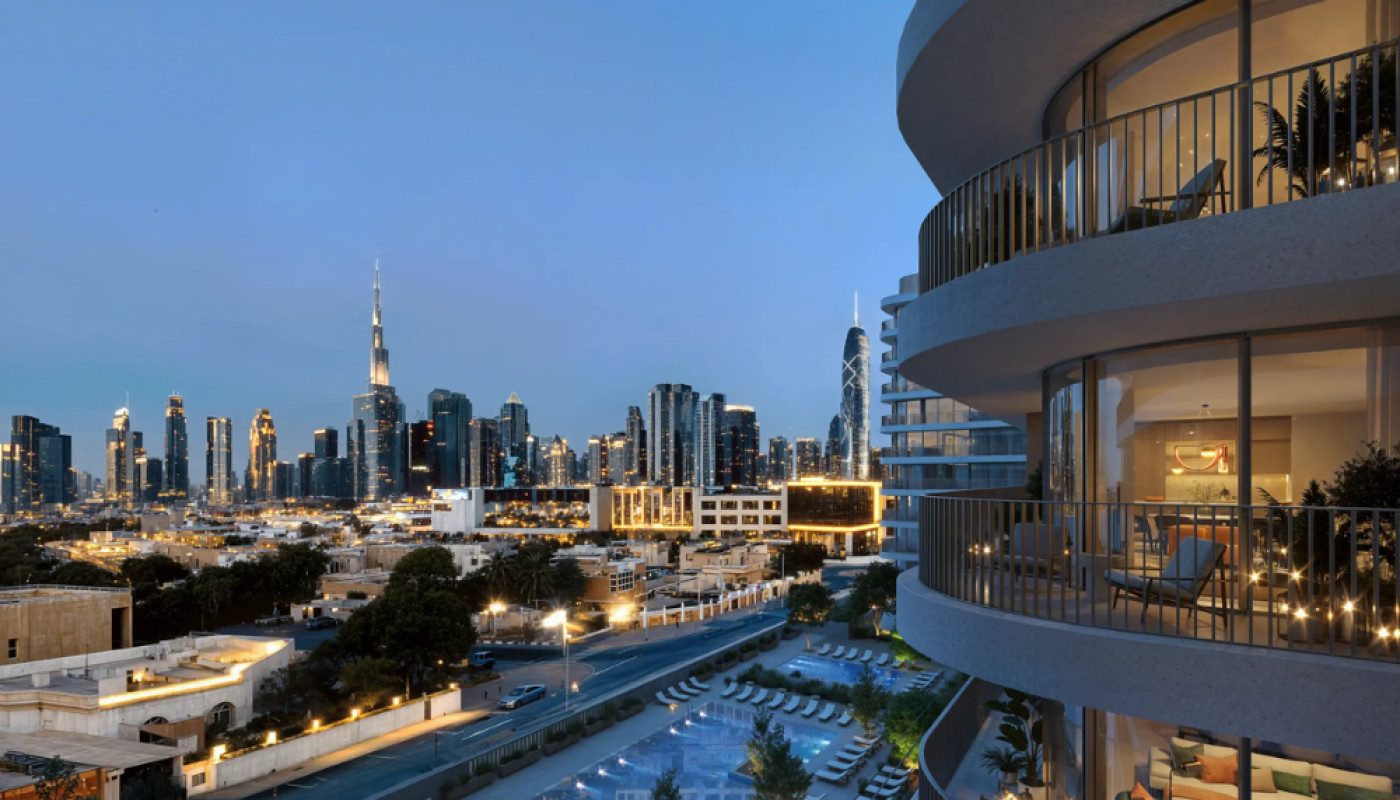
Eden House The Park slots into that lineage with intent. According to materials shared with introducing brokers, the project sits within the Al Wasl corridor, directly facing Safa Park, and is positioned as a “house” rather than a tower. The phrase is more than marketing. H&H’s pattern, repeated across its previous projects, is to build mid-rise, low-density volumes where the number of residences is measured in the dozens rather than the hundreds.
Al Wasl: A Neighbourhood Quietly Reinventing Itself
The location is half the story. Al Wasl, the stretch that runs between Jumeirah and Downtown along the canal, has long been the city’s most domesticated luxury postcode. It is where Dubai’s older villa stock sits beside designer boutiques, low-key cafes and a steady stream of families pushing strollers along Safa Park’s perimeter. Until recently, however, it had remained almost untouched by the new generation of branded residences.
That has begun to shift. JLL’s most recent residential market overview describes Al Wasl as one of the few central districts where new prime supply remains genuinely constrained, partly because of zoning, partly because plots rarely come to market. Bayut’s annual area report has tracked transaction prices in the corridor rising steadily through 2024 and 2025, with the strongest gains recorded for low-rise schemes directly facing the park or the canal.
H&H’s canal-facing house inherits both of those tailwinds. Its frontage onto Safa Park gives residents a permanent green outlook in a city where green outlooks are, by definition, finite. Property Finder’s research desk has noted in successive quarterly bulletins that “park-facing” and “canal-facing” stock in this micro-market commands a measurable premium over comparable inland product, and that the premium has widened rather than compressed since 2023.
Why The Park Frontage Matters
In Dubai’s luxury hierarchy, view protection is the quiet currency. Sea view can be replicated along multiple coastlines. Burj views are abundant by design. Mature park frontage, by contrast, cannot be manufactured: Safa Park is one of the oldest landscaped parks in the emirate, with canopy trees that took decades to reach their current scale. For a developer that builds around wellness, biophilia and family use, an address that opens directly onto that canopy is, in essence, the brief writing itself.
The Architecture: Restraint As a Statement
Visitors to the sales pavilion describe interiors that continue H&H’s established design grammar. Stone, oak and travertine recur. Ceilings are tall but not theatrical. Joinery is fitted rather than statement-piece. The lighting plot, designed in layers, favours warm temperatures and concealed sources over chandeliers. The result, brokers report, is closer in feel to a European boutique hotel than to the high-gloss interiors that have defined much of Dubai’s super-prime market.
The architecture follows the same restraint. The volume is mid-rise, the facade articulated in horizontal bands of stone and bronze-finished metal, with deep terraces shading the glazing. Landscape design, prepared by a specialist consultancy, extends the park’s planting palette up into the building, with mature trees on podium gardens and climbing greenery on selected facades. The intent, according to the project’s design narrative, is for the building to read as a continuation of the park rather than an interruption of it.
Amenities Calibrated for Residents, Not Brochures
The amenity programme has been one of the most discussed elements of the launch. Where many Dubai schemes lean on long lists of facilities, the new Al Wasl project appears to have been edited rather than expanded. The wellness floor, central to H&H’s model, includes a full spa with treatment rooms, a hammam, a sauna, a steam room and a dedicated cold-plunge area. A separate yoga and movement studio opens onto a landscaped terrace. The lap pool is sized for genuine swimming rather than display.
Beyond wellness, the residents’ offer includes a private cinema, a library, a children’s club with its own outdoor garden, residents’ lounges, a wine room and a fully serviced concierge desk. Valet parking, EV charging across the basement and a private drop-off court complete the operational layer. The model echoes, in scale and feel, the resident-only floors that have become a signature of London’s Knightsbridge schemes and Manhattan’s Madison Avenue conversions.
A Wellness Benchmark Built On Precedent
The Global Wellness Institute has repeatedly identified residential wellness as one of the fastest-growing segments of the global luxury market, and its most recent thematic report singles out the Gulf as a region where the spa-grade residential floor is rapidly becoming standard at the top end. Eden House Dubai Hills, completed by the same developer, has been cited in successive industry analyses as one of the early reference points for that category in the emirate. The Al Wasl project is widely expected to push the benchmark further, partly because the site allows for a larger wellness floor and partly because the operational team behind it has been recruited from the hospitality industry rather than from traditional residential management.
A Slower, Quieter Sales Process
The commercial choreography of the launch has been as deliberate as the architecture. Rather than an open release, H&H is working through a tightly managed list of introducing brokers, with private viewings by appointment and expressions of interest taken on a rolling basis. Knight Frank’s wealth and prime residential teams have noted, in conversations with sector media, that this “by-invitation” model is becoming more common at the very top of the Dubai market, mirroring the way London and Monaco have handled their most prized launches for years.
The pace is part of the proposition. Brokers active on the project describe a deal cycle measured in weeks rather than days, with multiple visits, layout customisations and detailed conversations about finishes before contracts are signed. For end-user buyers, often relocating with families, the slower tempo is part of the appeal. For the developer, it allows a more curated resident mix, which in turn protects the long-term character of the building.
Investment Mechanics In The Background
While the editorial framing of the project leans heavily on lifestyle, the underlying investment case is unusually clean. The UAE’s Golden Visa programme grants ten-year residency to property buyers above the AED 2 million threshold, a level that Eden House The Park comfortably clears. The emirate’s 0 per cent personal income tax and 0 per cent capital gains tax on residential property remain in force, and freehold ownership is available to foreign buyers in the Al Wasl freehold zones.
Knight Frank’s most recent wealth migration analysis has placed the UAE among the leading destinations for high-net-worth relocations globally, with Dubai capturing a significant share of that inflow. JLL’s hospitality and residential teams have separately observed that the city’s prime end-user segment, as opposed to its investor-led segment, has deepened markedly since 2023, with a measurable shift toward larger, family-sized units in low-density buildings. Both observations align closely with the format chosen for H&H Development’s flagship at Al Wasl.
A Launch That Sets a Tone
In a city accustomed to launches as theatre, Eden House The Park has chosen a quieter register. The pavilion is discreet, the marketing materials understated, the floor plans shared by appointment. Yet within the closed world of Dubai’s prime brokers, family offices and returning buyers, few launches in recent memory have generated as much sustained conversation. Part of that is the address. Part of it is the developer’s track record. Part of it is the simple recognition that the city’s luxury market is maturing, and that maturity tends to favour restraint over volume.
H&H’s pattern, repeated across Eden House Dubai Hills, Casa Tessuto and Casa Canal, is to deliver buildings that age well, both physically and in resale terms. Bayut’s resale data for the developer’s earlier schemes shows a consistent premium over comparable contemporaneous launches, a pattern that prime brokers attribute to the buildings’ low density and the operational quality of their amenity floors.
The Wider Market Context
Dubai’s prime residential market enters 2026 in a notably different posture than the one it occupied even three years earlier. Knight Frank’s most recent prime residential bulletin describes a segment that has matured from a primarily investor-led market into one increasingly shaped by end-user demand, particularly at the top end. JLL’s residential overview echoes the observation, noting that the deepest pricing strength has come from low-density, central, family-sized stock rather than from high-rise or high-volume product.
Bayut’s annual data has tracked, alongside the pricing trend, a structural shift in transaction patterns. Hold periods at the top of the market have lengthened. Resale velocity in low-density schemes has slowed even as resale pricing has firmed. Repeat-buyer activity, where existing residents of a building purchase additional units for family members, has become a measurable share of transactions in the most established prime addresses.
The Al Wasl corridor sits at the centre of that broader pattern. Its position between Jumeirah and Downtown, the maturity of its neighbourhood texture, and the constraint on new prime supply combine to produce a market context in which a low-density, wellness-led, family-oriented building is unusually well aligned with the dominant direction of demand.
Whether the Al Wasl project will continue H&H’s resale trajectory is, for now, a question for the resale market of the early 2030s. What is already clear, in the quiet weeks of its launch, is that the boutique-house model H&H has spent a decade refining has found, in Safa Park’s frontage, perhaps its most natural setting yet.
Similar
.jpg)
High-end complex in Meydan: The Symphony, an architectural masterpiece

Sint Maarten Real Estate: Invest in Paradise with 4U Real Estate

Best condos for sale in St Maarten with The Hills Residence

4U Real Estate : the best Caribbean agency for Your Real Estate Investment in Saint Martin

Exploring Investment Opportunities In Luxury Properties On A Tropical Island

Exploring The Benefits Of Investing In Caribbean Luxury Properties

Exploring The Advantages Of Investing In Luxury Properties With A Focus On Lifestyle Amenities And Exclusive Locations

Maximizing Your Investment: Tips For Property Owners Renting Out Holiday Homes In Ski Resorts
